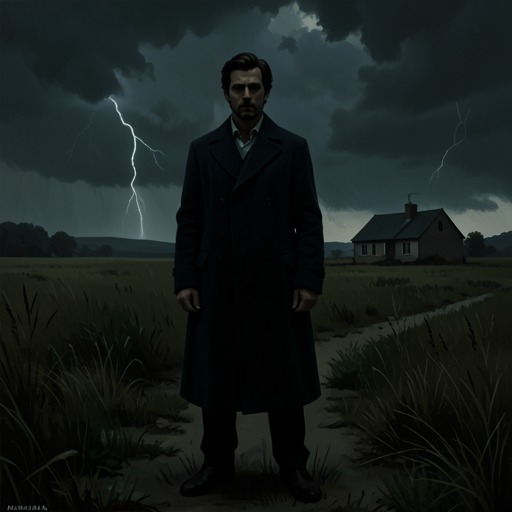
Boldwood’s detention by order of Her Majesty
Far from the Madding CrowdBoldwood’s detention by order of Her Majesty replaces the death sentence he received for shooting Troy with confinement at Her Majesty’s pleasure. The decision follows the discovery of evidence that his conduct had been shaped by mental derangement, and a petition asking the authorities to reconsider his punishment. Its reprieve ends the villagers’ suspense over whether he will be executed, while leaving intact the tragedy that led him to prison and Bathsheba in profound distress.
From the Christmas Eve crime to the gaol
After shooting Troy during the Christmas gathering, Boldwood left the house and travelled alone toward Casterbridge. He crossed Yalbury Hill and the open ground beyond it, reached the town between eleven and twelve, and entered the gaol through its stone archway. The door closed behind him; the narrative marks his passage into custody as a final departure from ordinary life. His crime had become known throughout Weatherbury, and the household he left behind was in disarray.
Gabriel Oak arrived at the house soon after Boldwood’s departure. Bathsheba was beside Troy, whom she had lifted and whose head she held in her lap. She asked Gabriel to ride for a surgeon, while acknowledging that help seemed useless, and identified Boldwood as the man who had shot her husband. The contrast between the two immediate outcomes is central to the episode: Boldwood entered the gaol, while Bathsheba had to face the death of Troy and the aftermath of the shooting.
Evidence of mental disturbance
In the days after the shooting, people familiar with Boldwood recalled that he had been unusually excited from Greenhill Fair onward, but they had not understood the change as clear evidence of mental derangement. A locked closet disclosed a more disturbing pattern. Inside were expensive women’s dresses, two muffs, and a case of fine jewellery containing bracelets, lockets, and rings. The purchases had been made in Bath and other towns and brought home secretly. Each carefully wrapped parcel was labelled for Bathsheba, with a date six years in the future.
The objects connected Boldwood’s private preparations to his obsessive attachment to Bathsheba and suggested that he had imagined a future with her as if it were assured. They were described as evidence of a mind crazed by care and love. Other signs were reconsidered once the possibility of insanity had been raised: notably, Boldwood’s unprecedented neglect of his corn stacks the previous summer. On its own, that neglect had not established his condition; retrospectively, it became one of several circumstances for which mental disease seemed to offer an explanation.
Petition and sentence reconsidered
Boldwood pleaded guilty and was sentenced to death. Evidence elicited before trial had already pointed toward diminished responsibility, but had not been considered sufficient to require an examination of his mental state. The closet’s contents and the recollections of his earlier behaviour strengthened the case for revisiting the sentence. A petition to the Home Secretary asked that the new circumstances be considered and that the crime be viewed as an outcome of madness rather than wilful murder.
The campaign for reconsideration was not a broad popular movement. Boldwood had few friends among Casterbridge’s shopkeepers, and the petition was advanced by a small group of merciful men who had been moved by the newly disclosed facts. Local resentment toward Boldwood also reflected his habit of buying directly from producers rather than relying on town shops. The community’s response therefore combined sympathy for his condition with the social distance he had maintained in life.
The reprieve and its limits
The execution was fixed for eight o’clock on a Saturday morning, roughly a fortnight after the sentence. By Friday afternoon, Weatherbury had still received no answer to the petition. Gabriel returned from Casterbridge Gaol after spending more than two hours with Boldwood and told the villagers there was no news and little reason to hope. Although he could not honestly say Boldwood had been out of his mind when he committed the shooting, Gabriel still hoped that his life would be spared, remembering qualities in the farmer that he loved.
The villagers waited for word through the evening. Liddy reported that Bathsheba had deteriorated again after seeming to improve: since Christmas she had become so altered that someone who had not seen her for two years would scarcely recognize her. She repeatedly asked whether Gabriel had returned and whether there was news. Her distress made the decision about Boldwood’s fate more than a question of punishment for the village, though it did not resolve the loss of Troy or the consequences of the shooting.
At eleven, Gabriel and several of Bathsheba’s workers waited on the road for Laban Tall, who had been sent to Casterbridge. When Tall arrived, he reported that Boldwood was not to die: the sentence had been changed to confinement during Her Majesty’s pleasure. The news released the immediate suspense, and Jan Coggan greeted it with relief. The outcome was reprieve, not restoration: Boldwood remained in custody, while the evidence of his crime, Bathsheba’s grief, and the damaged lives around him continued to define the aftermath.